
Hardwood Floor Repair in Sioux Falls, SD | Sioux Falls Hardwood Flooring
Sioux Falls Hardwood Flooring, a hardwood flooring contractor, has provided hardwood floor repair for homeowners throughout Sioux Falls, South Dakota for 15 years. Most calls involve damage to one section of the floor rather than an entire room. Whether you have a single stained board, a worn area near a doorway or a section that creaks underfoot, you don't need to replace the whole floor. We repair the damaged area while leaving the surrounding hardwood flooring in place.
Our hardwood floor repair services include single-board replacement, squeak repair, gouge and dent repair, gap filling, and blending repaired areas into the surrounding finish. We match replacement boards to your existing hardwood and lace them into the floor, keeping the seams aligned with the original pattern. All work follows NWFA installation guidelines, and we work with waterborne polyurethane, oil-modified polyurethane, and hardwax oil finishes.
We cover Harrisburg, Brandon and Tea as well, across both Minnehaha and Lincoln counties. Call (605) 799-9142 for a free on-site estimate, or use the quote form to request a proposal.
Get A Free Estimate
Hardwood Floor Repair Services
Hardwood floor repair focuses on the damaged section while leaving the rest of your floor intact. The work stops where the damage ends and sound wood begins, so even a split plank near a doorway is a small repair, regardless of the size of the living room. Most damage occurs in predictable areas: high-traffic spots, places where liquid collects, and edges where boards are trimmed to fit around other surfaces or fixtures.
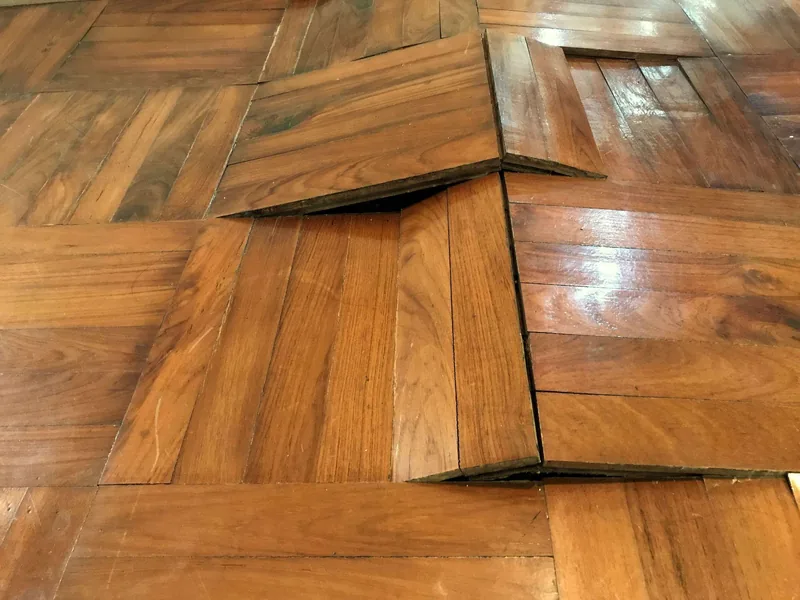
Single-Board and Small-Patch Replacement
Single-board replacement lifts one damaged plank out of the field of the floor and puts a new one in its place, without disturbing the surrounding floor. This repair is appropriate when a board has split lengthwise, cracked across its width, or lifted at the edges while the surrounding boards remain flat and dry. The same approach works for damage affecting a short section of flooring with sound boards on either side. For a small patch, we remove and replace several adjacent boards together. Before cutting begins, we match replacement board stock to what you already have, and the wood floor repair is priced per board.
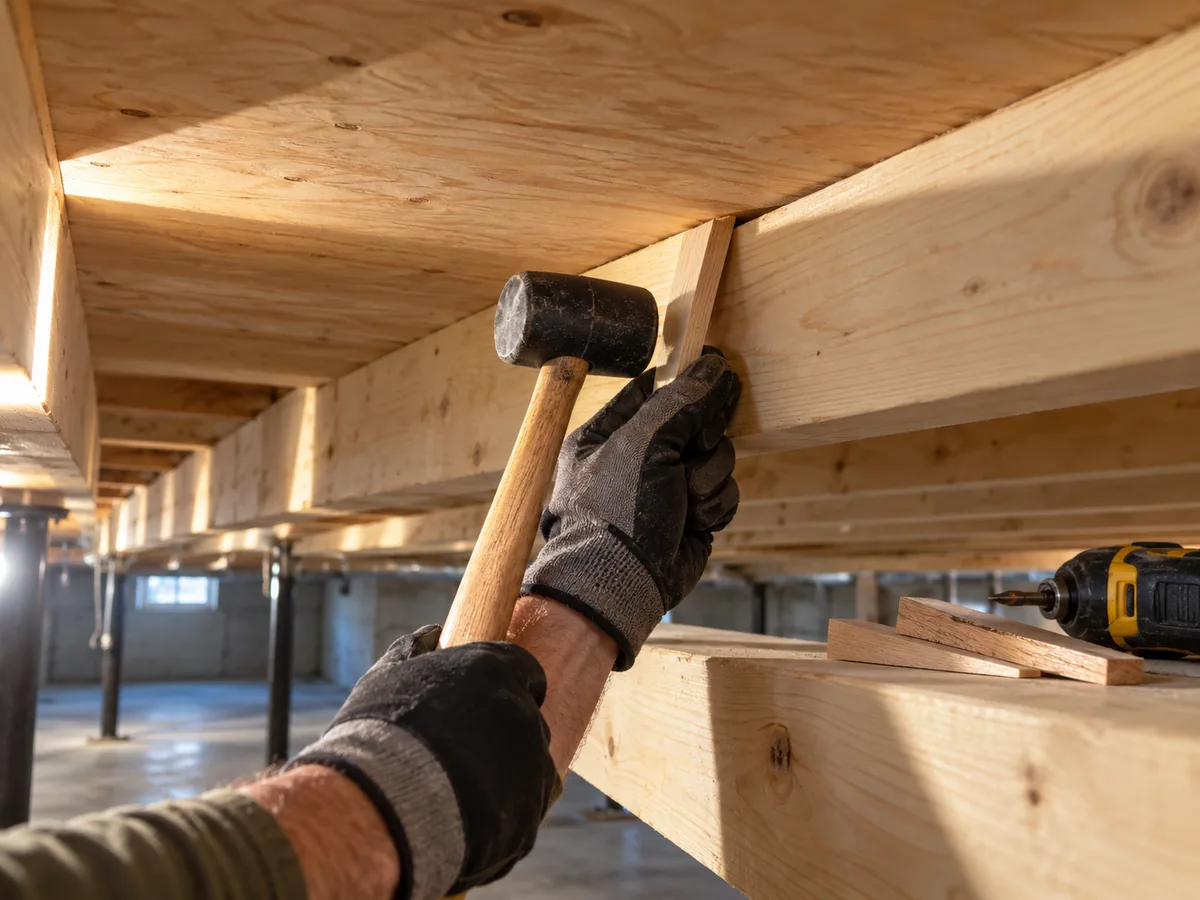
Squeaky and Loose Board Repair
A squeaky floor means something beneath your feet is moving. When a hardwood board is securely nailed to the subfloor, the layer of wood or panel beneath the finished flooring, it stays firmly in place. Once that connection loosens, the board shifts slightly with each step, causing the squeak. A loose board that moves under your weight has the same problem, while a hollow sound when you walk across a section of flooring indicates that the boards are bridging a gap underneath.
The movement can come from the flooring itself, a loose fastener, the subfloor, a joist, or the connection between any of these parts, so we locate the source before making repairs. Our approach depends on whether we have access from below through a basement or crawlspace. When we can reach the underside, we insert hardwood shims with construction adhesive into gaps between the subfloor and joists, then use screws to pull the subfloor tight against the flooring. Each screw is sized and positioned to stop short of the finished floor surface.
When we make the repair from below, the finished floor usually shows no visible signs of the work. If underside access is unavailable, we install trim-head screws from above and cover each hole with a plug cut from matching wood rather than filler. Older Sioux Falls properties often have uneven subfloors and varying joists, so we check the access before quoting, per board. Sheathing that has failed outright is restoration work.
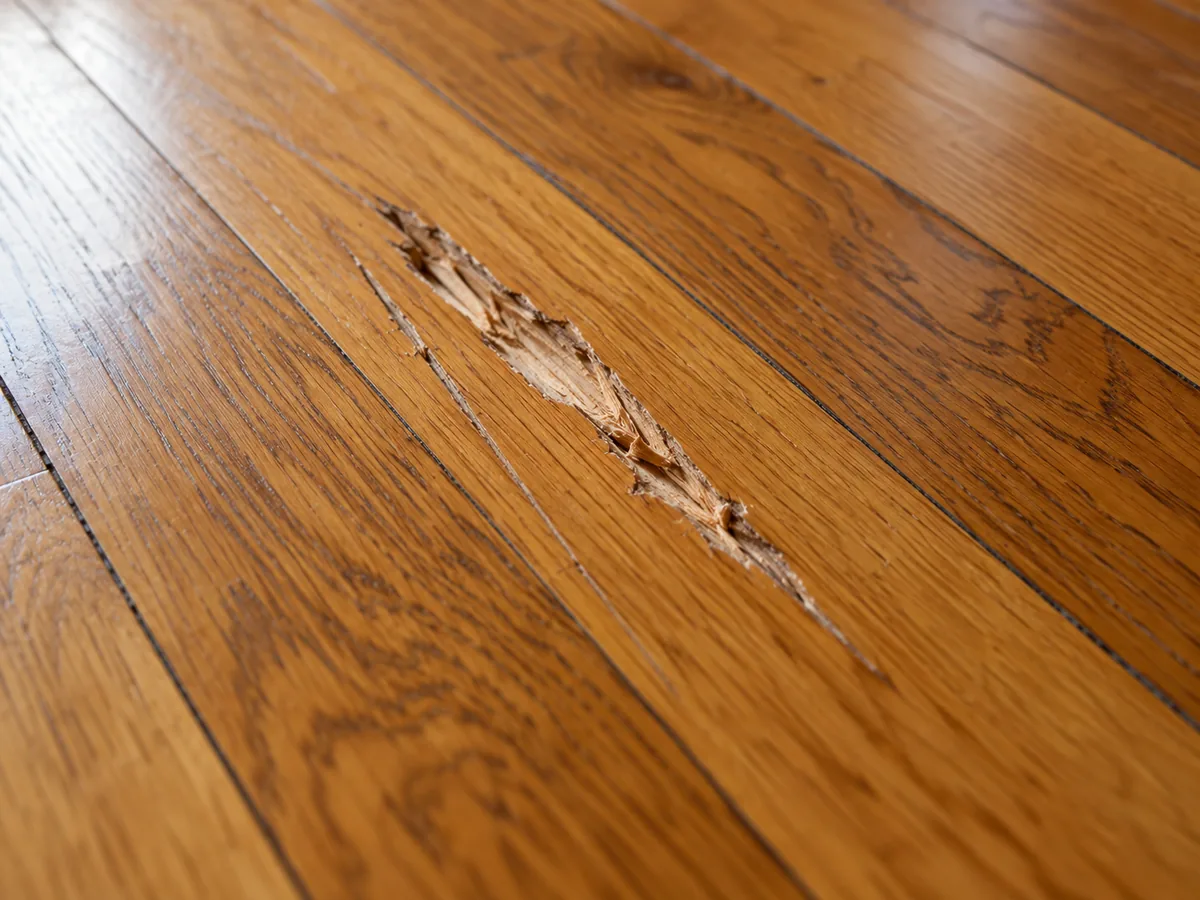
Scratch, Gouge, Dent and Stain Repair
Scratch and gouge repair depends on how deep the damage extends into the wood. Shallow marks are filled and blended into the surrounding finish, while deeper damage requires board replacement. For a dent confined to the finish, we use species-matched wood filler tinted to match the surrounding boards, then blend the repaired area into the existing finish.
The color of a water mark is a first clue to how far down it has gone. A white ring left by a planter or glass is trapped within the finish film and can be removed with a spot repair, while a dark stain has penetrated the finish and reached the wood beneath. Pet stains and burn marks also vary in depth. Shallow discoloration and charring can be repaired in place, but anything deeper takes the board. In the worst cases, the contamination extends through the hardwood and into the subfloor.
Black spots from pet stains require a different approach. Oak contains tannin, a natural compound in the wood that reacts with uric acid in urine and turns black. This discoloration can extend through the full thickness of the board, beyond the reach of sanding, and bleaching is unreliable at that depth. When the damage runs that deep, we remove the affected board, seal the surface beneath it, and install a replacement. Because color alone does not settle it, we inspect each stain before recommending a repair or replacement. We also make it clear when a mark cannot be completely removed.
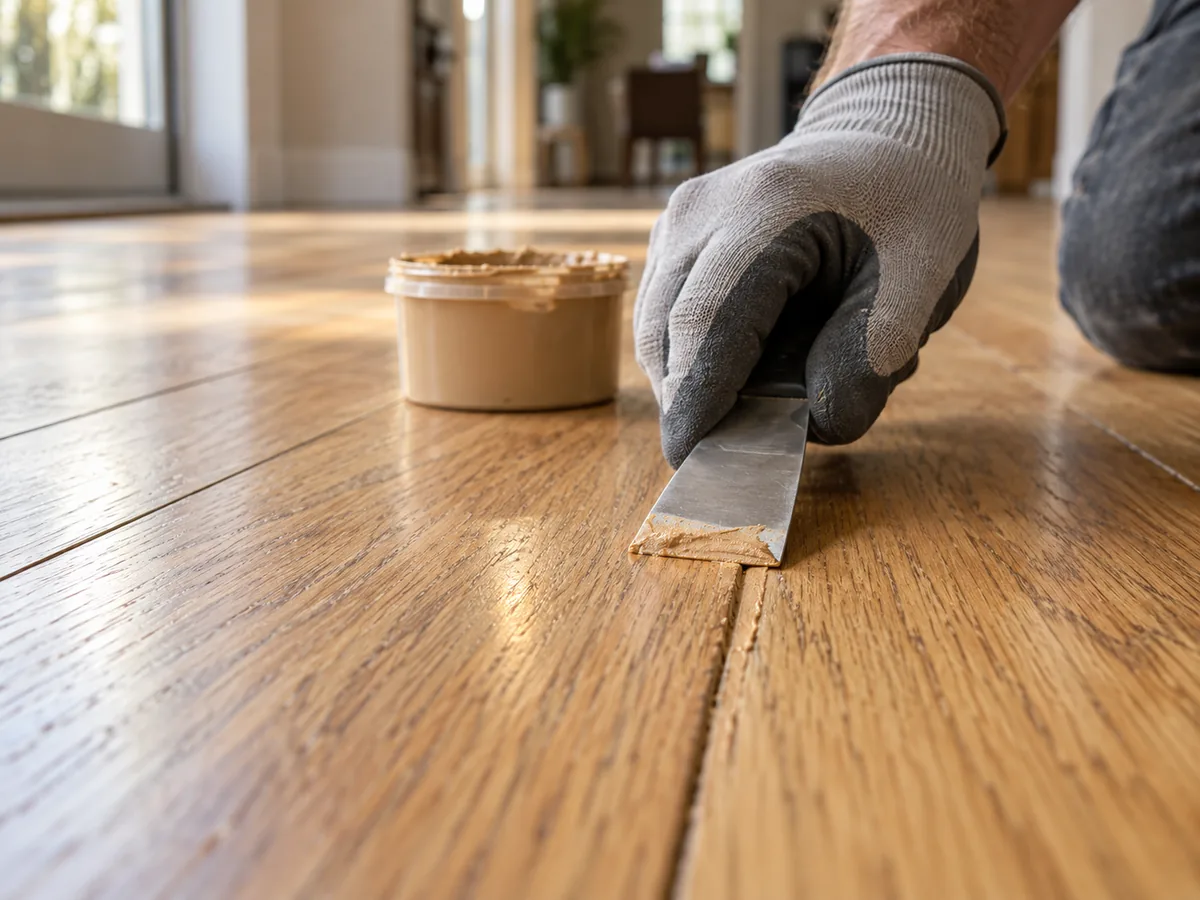
Gap and Crack Filling Between Boards
Gap filling closes open joints between hardwood boards using species-matched wood filler, but not every gap needs to be filled. Hardwood boards shrink during the heating season and expand again in summer, so a gap that appears in January and closes by July is normal and best left alone. Filler packed into a joint that is still moving cracks out and shows as a pale line, which looks worse than the gap did.
A gap that remains open through the summer is different from normal seasonal shrinkage and needs a closer look. We check the moisture levels, movement and width of the joint to determine whether species-matched filler or a sliver of matching wood is the better repair. Gaps between boards are priced by the linear foot of joint.
Floor Vent, Threshold and Transition Repair
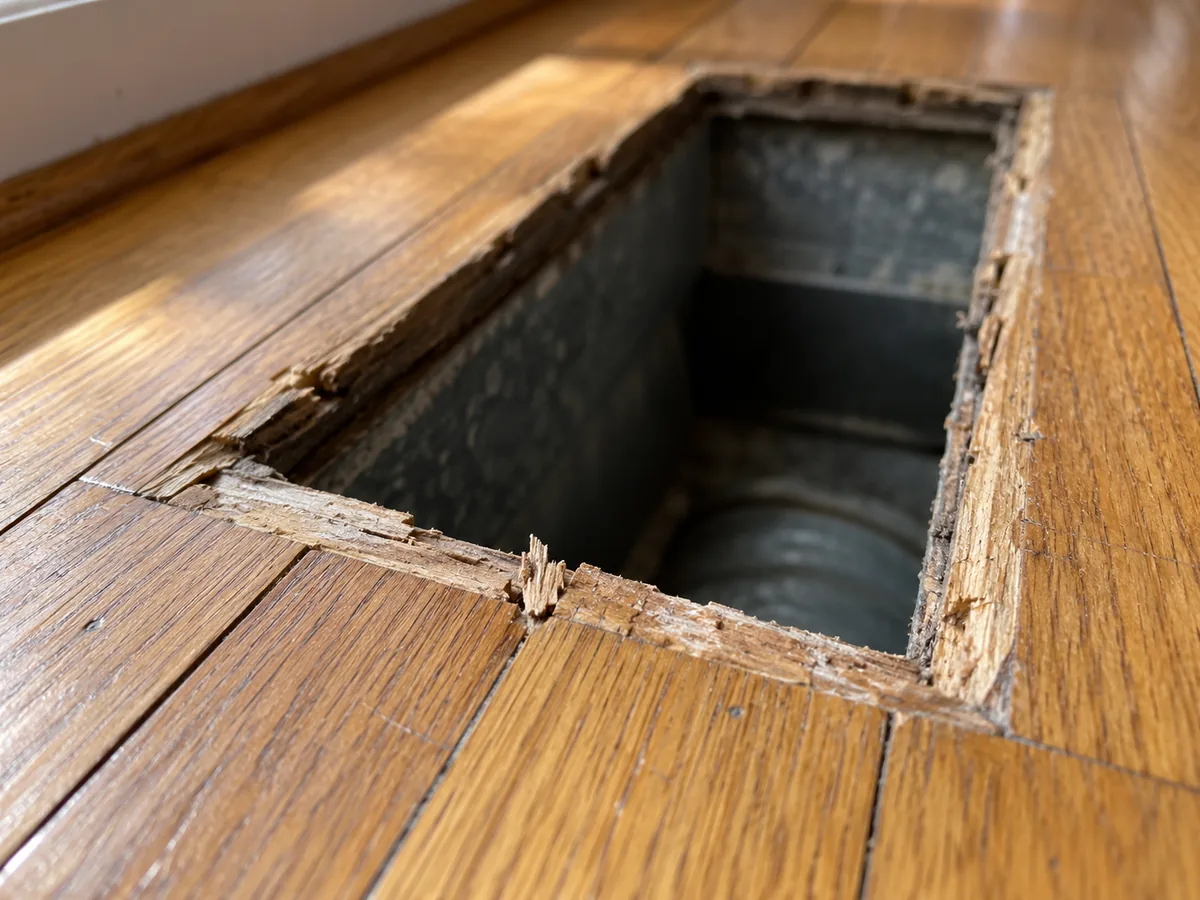
Your hardwood floor is most vulnerable where boards have been cut, especially around the hardware fitted into those openings. These are some of the areas we repair most frequently. Floor vent openings leave cut edges exposed on all four sides, without neighboring boards to support them, so foot traffic and vacuum cleaners gradually chip away at the corners. Doorway thresholds take the weight of every person entering the room, while the cut ends of the boards expose end grain, the open wood fibers at the sawn edge that absorb spilled liquids.
Reducers, which provide a transition to a lower floor, and T-moldings, which connect two floors at the same height, both loosen as the cut edges of the flooring move. We remake oak vent covers using wood stock milled to match your floor, and replace loose reducers and T-moldings to restore a secure fit.
Pricing
Hardwood Floor Repair Costs in Sioux Falls
We publish hardwood floor repair costs for three common types of work, with each price based on a specific unit of repair rather than the total cost of an entire room.
- Single-board replacement, $125 to $350 per board
- Squeak repair, $65 to $135 per board
- Gap filling, $2 to $4 per linear foot
The price of your hardwood floor repair within those ranges depends on the type of wood, access to the damaged area, and how much of the surrounding floor needs refinishing. Replacement board stock for an older floor costs more when the original width is no longer manufactured, making matching stock harder to find. A squeak we can reach from the crawlspace below costs less to repair than one that requires working from the finished floor above. Likewise, filling a damaged spot costs less than replacing the entire board, and blending a repair into a larger section of flooring adds to the finishing and coating work.
We inspect and measure the repair needed on your floor at no charge, then prepare a written proposal using these same prices, with the quantity of work and rate clearly listed before the job begins.
How We Repair and Match Existing Hardwood Floors
Every hardwood floor repair has two parts. First, we remove the damaged material and fasten the replacement so it cannot move. Then we match and blend the new wood into the surrounding floor so the repair no longer stands out. We start with the work hidden beneath the surface and finish with the details you will still notice months later.
Removing and Lacing In Replacement Boards
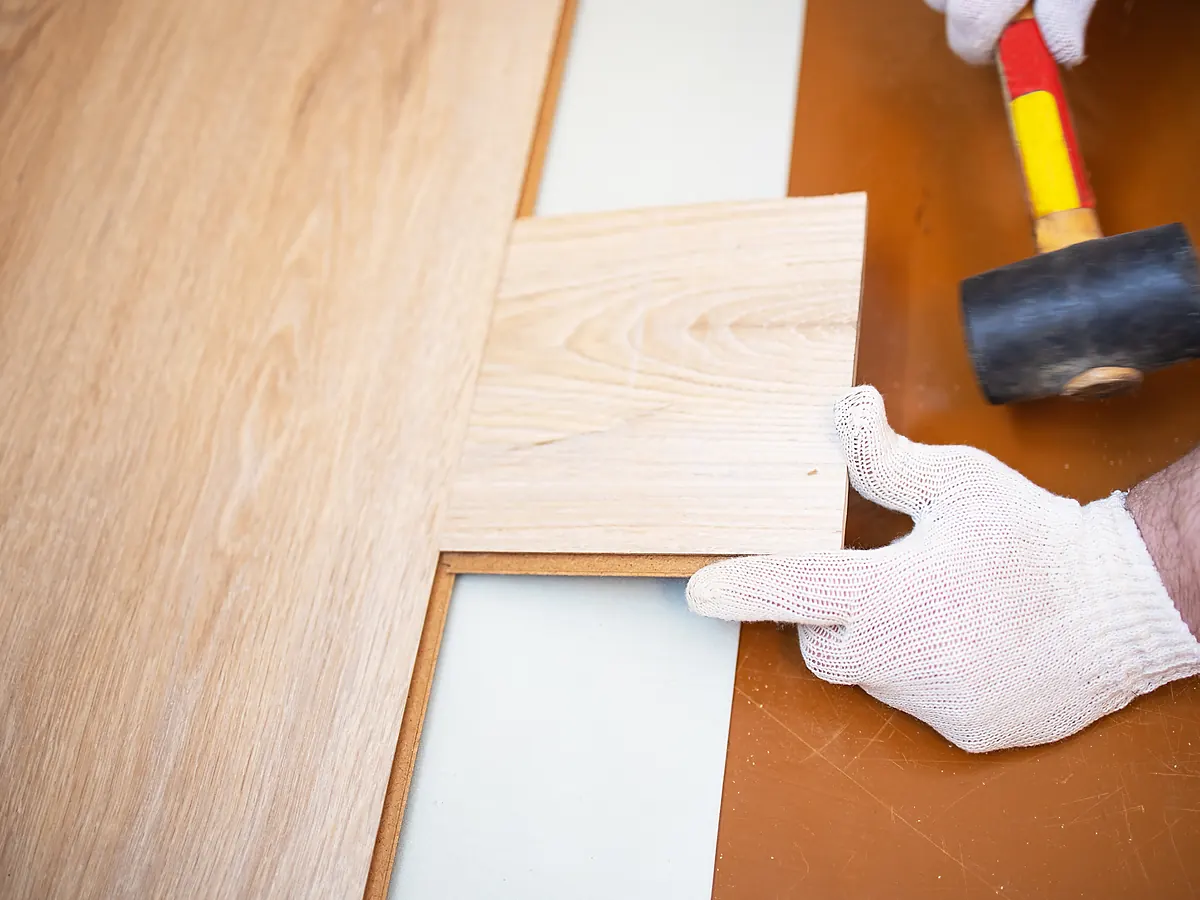
Each hardwood board is joined to its neighbors by tongue and groove, a ridge along one edge fitting into a matching slot on the next board. That locks the run on all four sides, so to cut out a board you have to destroy it without marking the ones around it. We first cut down the center with a plunge saw, setting the blade just short of the board's full thickness, slightly less than three-quarters of an inch for solid hardwood, to avoid cutting into the subfloor. We then split out the tongue side, free the groove side with a chisel, finish the end cuts with an oscillating multi-tool, and remove every nail and staple.
Once the damaged boards are replaced, the patch needs to blend into the original flooring, and the placement of the end joints makes the difference. Cutting out a neat rectangle leaves a visible outline because the end joints line up in straight rows. Instead, we use a technique called lacing, fitting replacement boards into the existing pattern one at a time. By extending the repair into sound flooring on alternating rows, we keep the joints staggered and irregular, matching the layout of the surrounding hardwood.
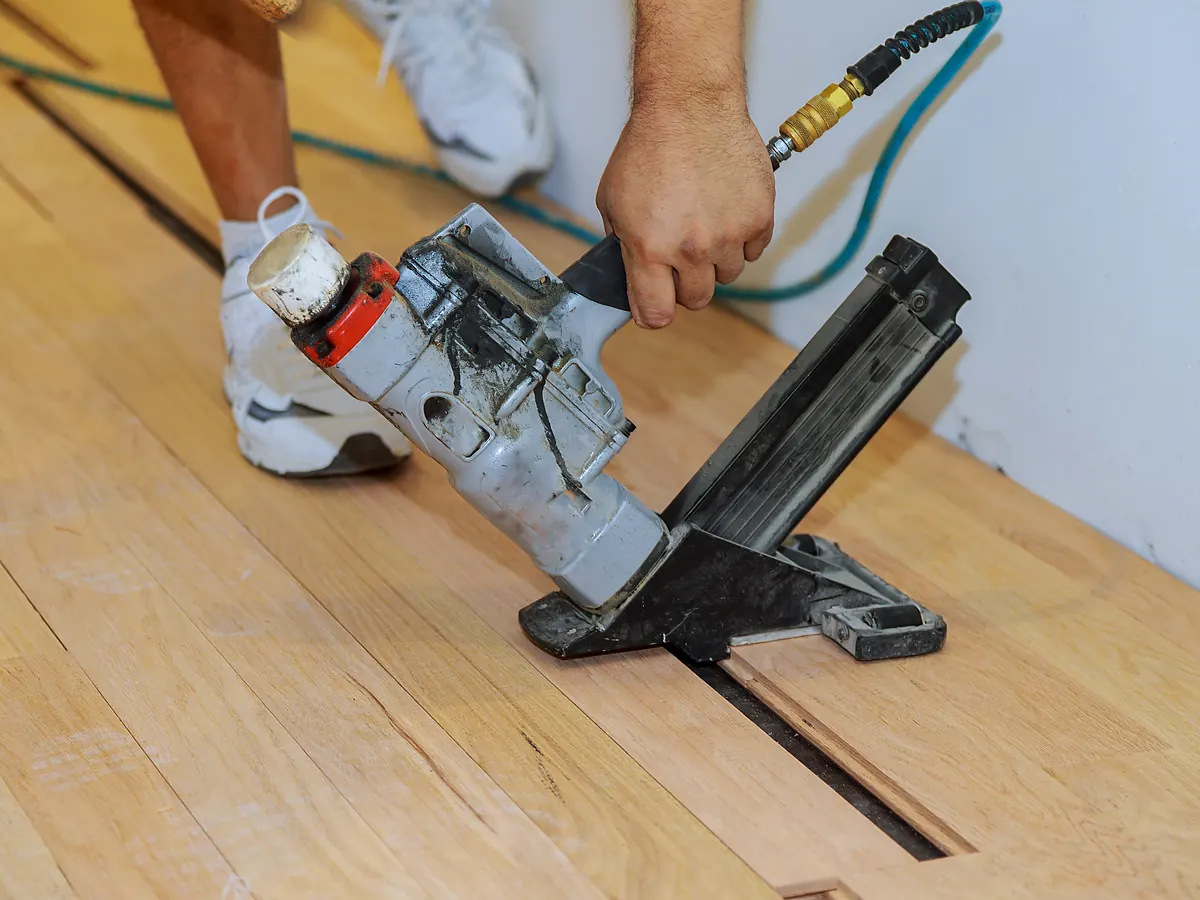
We fasten each replacement board through its tongue with a cleat nailer, the same installation method used on the original floor. The final board cannot drop into a slot, so we remove the bottom of its groove, construction adhesive holds it in place, and two fasteners driven through the face are filled with species-matched wood filler.
Matching Wood Species, Width and Grain
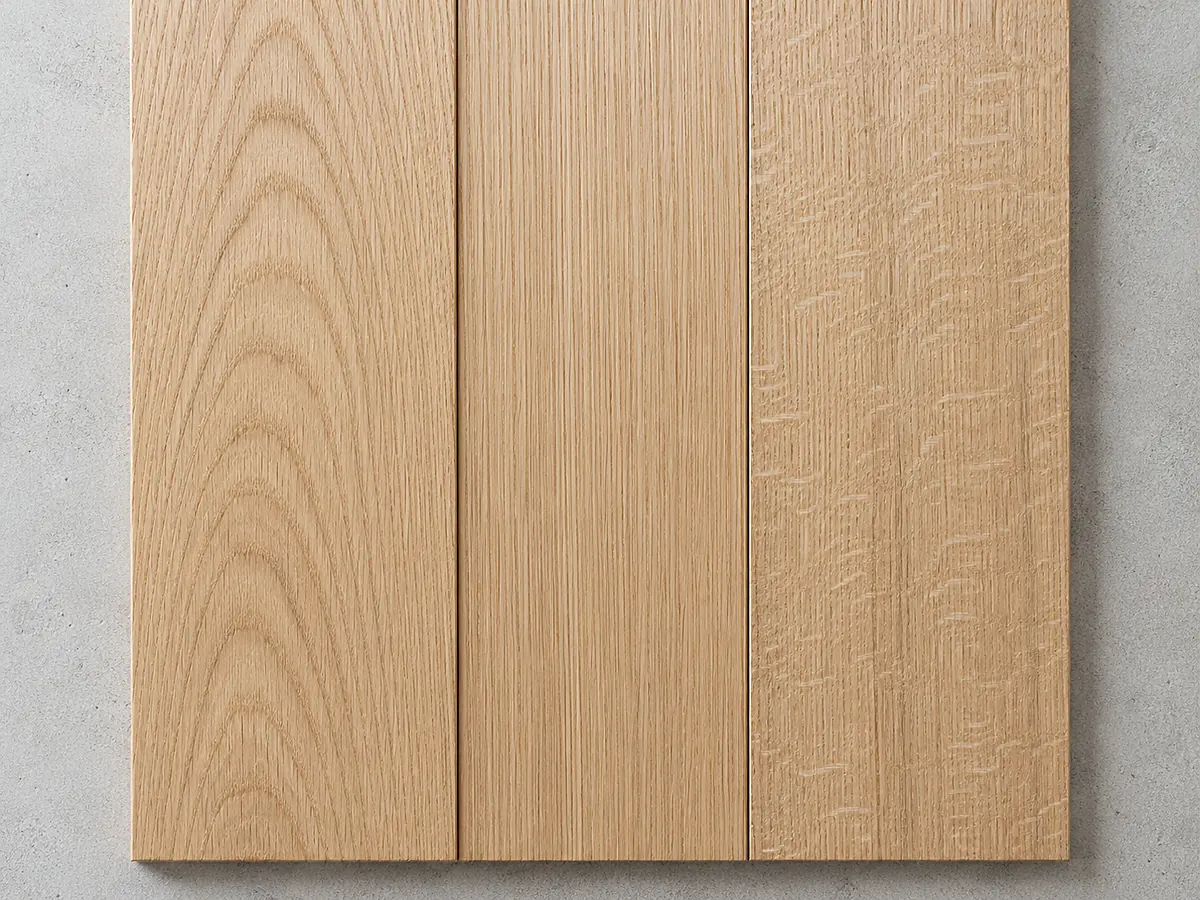
We start with species matching, because even two boards from the same species can look noticeably different. White oak, red oak and hickory are not interchangeable, and the way each board was sawn also affects its appearance. Quartersawn oak has growth rings that run roughly perpendicular to the board's face, producing a straighter grain with distinctive flecking. Riftsawn oak is cut at a shallower angle to produce a straight grain without that flecking. Plainsawn oak, the most common cut, is sawn straight through the log and has the broader, more varied grain pattern found in most hardwood floors.
The board width has to match your existing flooring, commonly 2 1/4 inch strip in houses of that era, with the grain direction aligned during installation. Before fitting the new board, we condition it to the room, as NWFA installation guidelines direct. How dry it should be depends on the wood species, season, conditions inside your home and the manufacturer's specifications, not any single rule.
Blending Stain and Finish to the Existing Floor
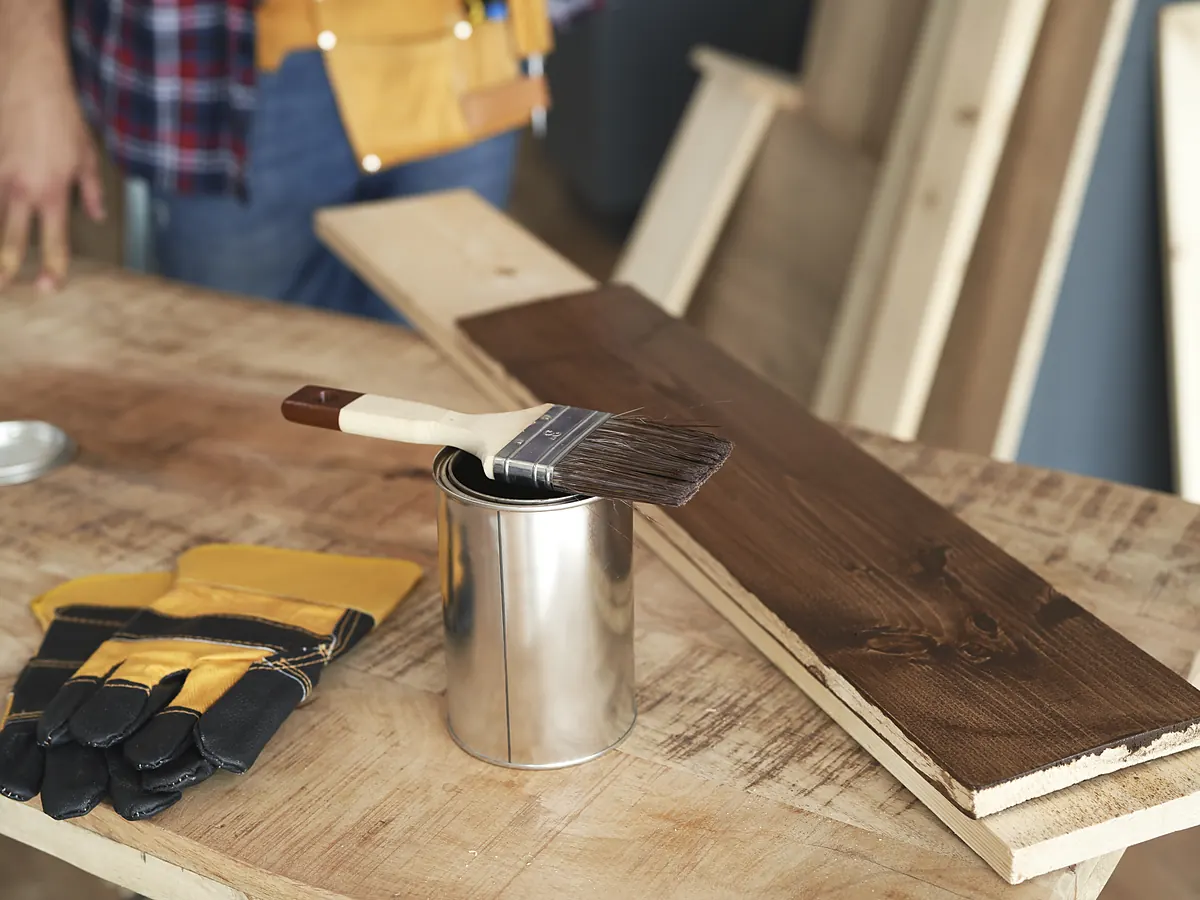
We extend the new finish beyond the repaired area so the patch does not sit in a brighter or duller rectangle, and finish matching turns on how far we carry it. Over time, sunlight and foot traffic change the color of hardwood, so we mix a stain match to your floor as it looks today rather than to a swatch, using DuraSeal and Minwax colors. Your floor carries one family of finish, usually an oil-modified polyurethane or a hardwax oil, and that family sets how the blending is done. A board edge shows as a line, so we stop at a doorway or a wall.
When Spot Refinishing Will Not Work
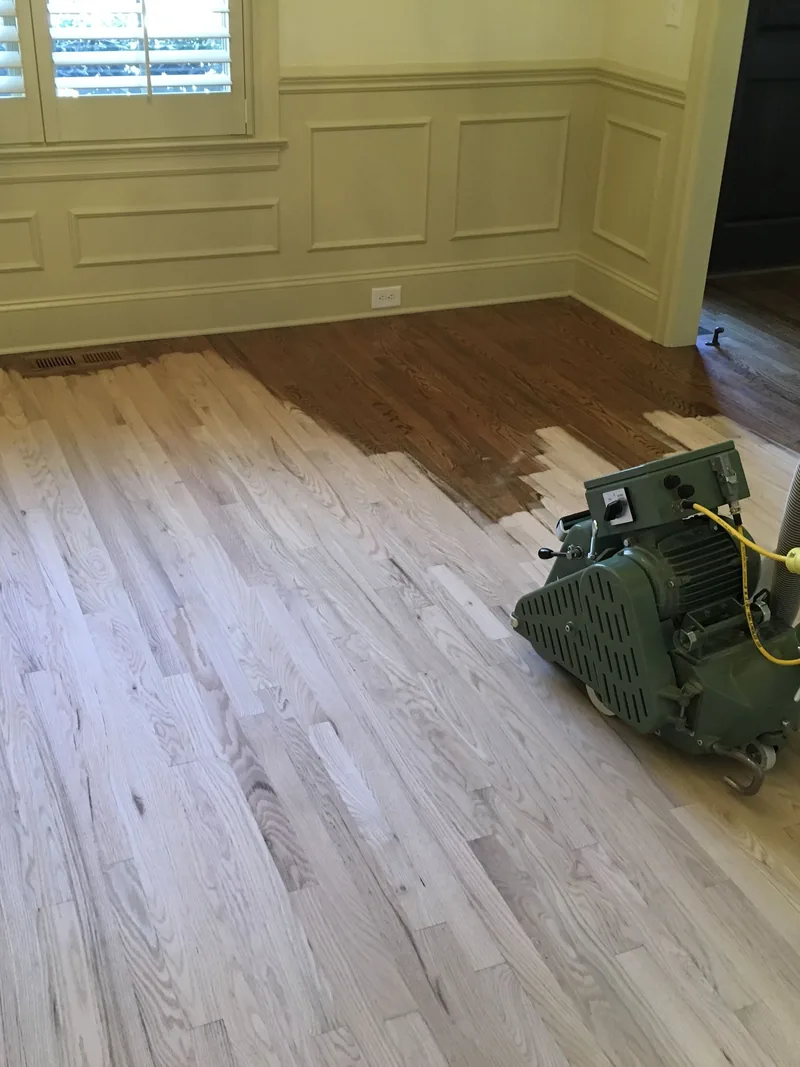
We limit sanding and coating to the repaired area and the surrounding floor, a process called spot refinishing that avoids the cost of refinishing an entire room. For the new coating to blend without a visible edge, the existing finish around the repair must be in good condition. If that finish has worn through or faded unevenly across the room, blending alone will not conceal the transition between the old and new finish.
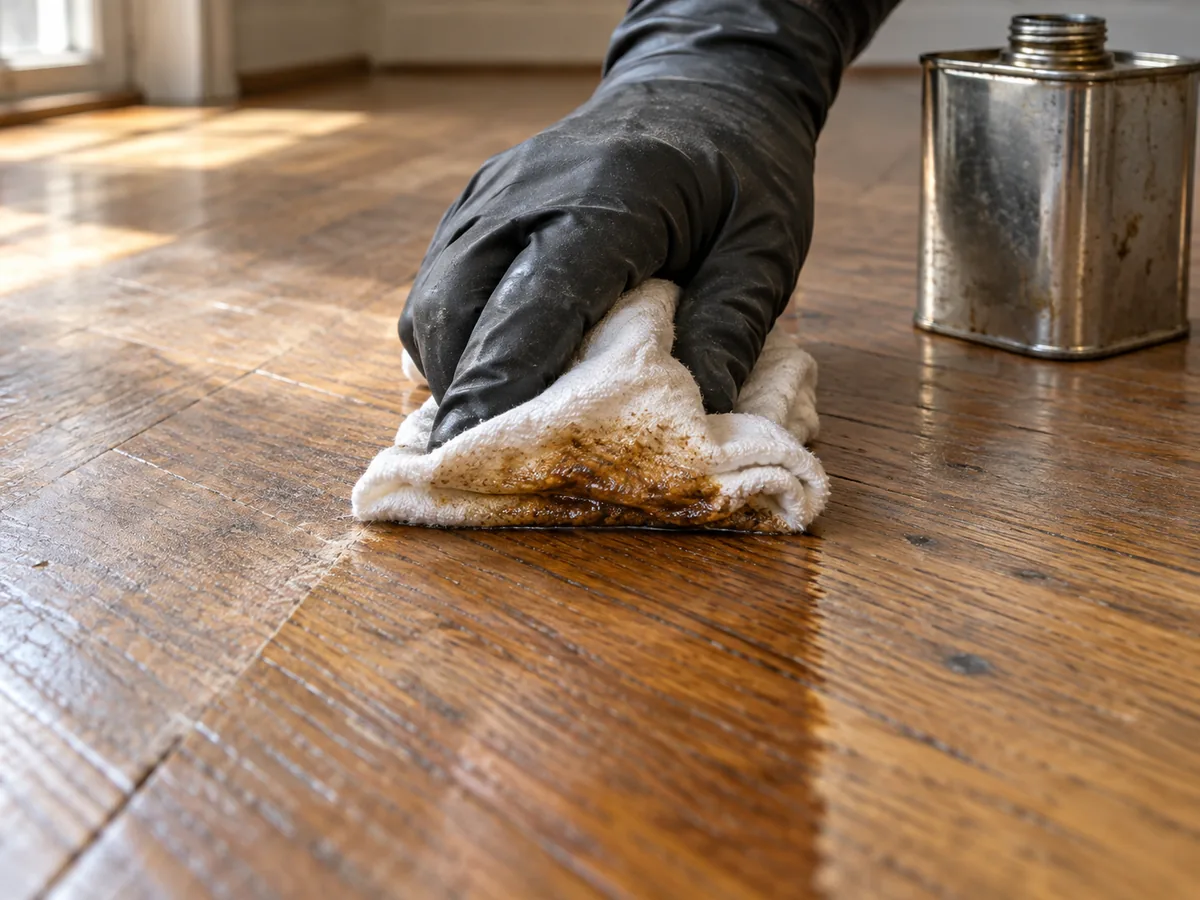
The products used to maintain your hardwood floor over the years matter just as much as the wood itself. Older floors were often treated with surface dressings such as paste wax or acrylic polish, which leave a soft layer on top of the boards rather than curing into a sealed finish. A new finish will not bond properly through either coating, so we must strip the old dressing before refinishing. This adds work beyond the original repair and requires a separate discussion about price. To identify the existing coating, we wipe the surface with mineral spirits. Wax transfers onto the rag, while an acrylic film remains in place.
When a spot repair cannot be blended into the existing finish, the alternatives are hardwood floor refinishing, which involves sanding and coating the entire floor, or a screen and recoat, which buffs that finish and applies a fresh coat over it.
Repair, Refinish or Replace: Which Does Your Hardwood Floor Need?
A damaged hardwood floor has three possible solutions, and the right choice depends as much on the condition of the surrounding flooring as on the damage itself. Where that surrounding floor is sound and the damage is limited to a few boards, hardwood floor repair is almost always the answer. The following conditions are what make a more extensive repair or refinishing necessary:
- Damage spread across most of a room, where repairing one section leads to more damaged boards that need attention.
- A floor that has been sanded several times, leaving little wood above the tongue and not enough material for another sanding.
- A finish worn through across the entire floor rather than just the main walking areas, making floor sanding and refinishing a better choice than individual patches.
- A wet floor that needs to be dried and assessed before repairs begin, which we handle as a separate service.
- Failed subfloor sheathing or a glued hardwood floor that has separated from the slab across a large area, both of which require restoration rather than a standard repair.
The two answers are priced in different shapes, a repair by the board and a new floor by the area covered. Choosing the right approach means looking at how far the damage extends, what the boards around it still have left, and how the repair price compares with refinishing or replacing the floor. Many hardwood floors that appear to need replacement are actually good candidates for restoration, allowing you to keep your existing flooring along with the age and character it has developed over the years.
Repairing Prefinished and Engineered Hardwood
Two hardwood floors that look identical can require different repairs depending on whether the finish was applied at the factory or on-site, and whether the boards are solid hardwood or another construction. Some flooring also has a sanding limit that solid hardwood does not, restricting how much material can be removed during repairs. We identify your flooring type and finish before preparing a quote so the recommended work stays within what the material allows.
Prefinished Boards: Micro-Bevels and Matching Limits
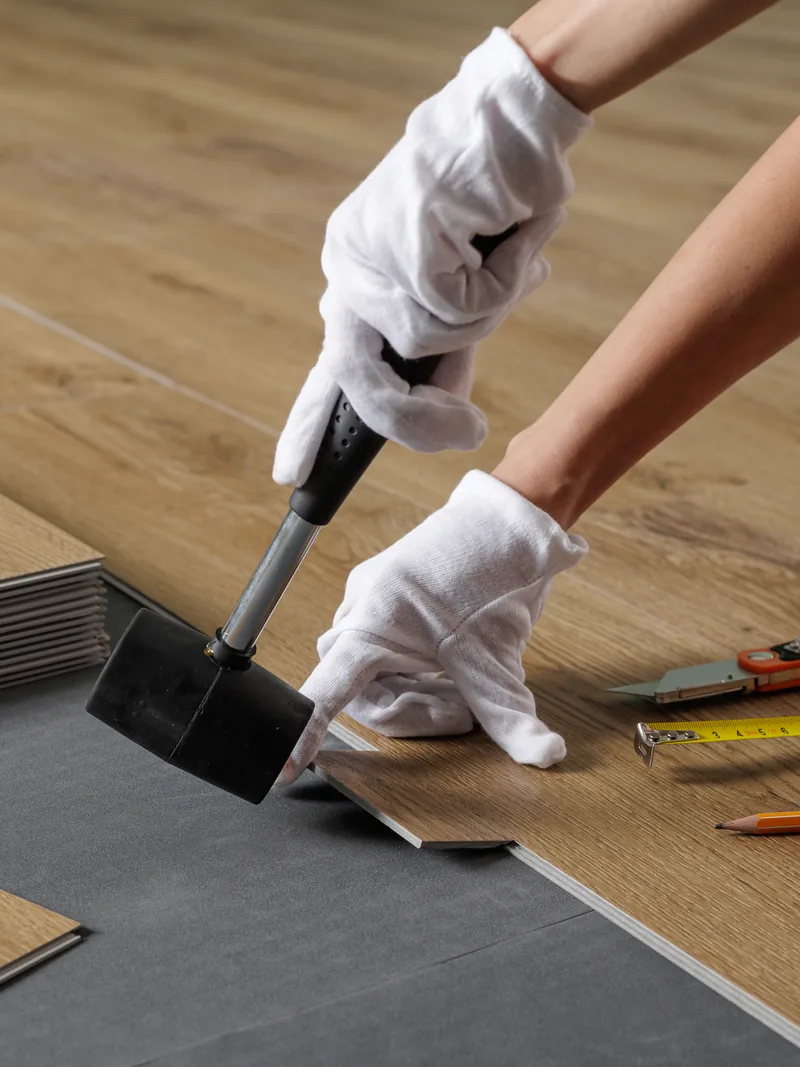
Prefinished hardwood boards arrive from the factory already sanded and coated, with a slight angle along each long edge. This is called a micro-bevel, a narrow chamfer that creates a visible groove where two boards meet. When we find a replacement board that matches your existing floor in width, thickness, edge profile, color and sheen, we remove the damaged plank and install the new one without any additional sanding or finish blending.
The main challenge is finding a matching replacement board, since manufacturers discontinue product lines and your exact flooring may no longer be available. Sanding a prefinished floor flat removes the micro-bevel grooves between boards. A site-finished floor, by contrast, is coated after installation, has no such grooves, and allows the repaired area to blend seamlessly into the surrounding finish.
Engineered Hardwood Wear Layers
Engineered hardwood flooring is not made of solid wood throughout. Instead, it has a thin layer of real hardwood bonded to a plywood core. That top layer is the wear layer, the only part a sander can touch, and its thickness determines how many times the floor can be sanded and refinished.
NWFA sanding guidelines set the minimum wear layer thickness at 3/32 of an inch, approximately 2.5 mm. Below that thickness, the floor should not be sanded. Above it, the remaining wear layer provides an indication of how much sanding is possible, not a guaranteed number of future sandings. Existing wear, the amount of wood removed during each sanding, and the manufacturer's specifications all affect that limit. We measure the wear layer remaining on your floor rather than relying on the original product specifications. Engineered floor repair at board level follows the same process as solid hardwood, although removing boards bonded to a concrete slab with urethane adhesive requires more work.
Why Choose Sioux Falls Hardwood Flooring
When you pay for hardwood floor repair, you are paying for work that stops being findable, and the sections above are how we get there. What a wood flooring repair company owes you beyond that is on paper.
- You receive a written, itemized proposal that clearly lists the scope of work and material specifications, line by line.
- We document any concealed damage we uncover and get your approval before performing additional work.
Sioux Falls Hardwood Flooring is a local company with 15 years in business. We carry the insurance and bonding applicable to our work and can provide documentation on request. Dust containment runs on every sander we use, on every job. Flooring and finish materials carry their manufacturer's warranty. We provide free estimates and offer financing for larger projects.
Call us at (605) 799-9142 to discuss your hardwood floor repair project, or fill out the quote form whenever it's convenient for you.
What to Expect From Your Free Repair Estimate
A free estimate from Sioux Falls Hardwood Flooring starts with a visit, because an accurate repair price means inspecting the floor in person rather than relying on photographs. Our estimate process has three steps:
-
1.
We inspect the damaged area in person and check the boards around it.
-
2.
We identify what your floor is and find matching replacement stock to establish the material price.
-
3.
We provide an itemized written proposal detailing the work and its price, and no cutting begins until you approve it.
Service Area
Floor Repair Across Sioux Falls and the Surrounding Towns
Winter causes much of the hardwood floor damage in Sioux Falls. The heating season runs roughly from October through April, keeping indoor air dry for months at a time, while boards near exterior doors experience the most wear. Many older homes in the area have narrow oak strip flooring, so that wear affects numerous smaller boards rather than a handful of wider planks.
Even if you live outside Sioux Falls, a handful of damaged hardwood boards is worth repairing. We serve Brandon, Harrisburg, Tea, and other communities across Minnehaha and Lincoln Counties. Sioux Falls Hardwood Flooring travels throughout this service area, including communities in neighboring counties, for jobs of all sizes.
Communities We Serve
- Brandon
- Harrisburg
- Tea
- Hartford
- Dell Rapids
- Lennox
- Canton
- Crooks
- Baltic
- Worthing
- Valley Springs
- Garretson
- Humboldt
- Colton
- Renner
- Chancellor
FAQ
Floor Repair Questions From Sioux Falls Homeowners
Can you repair part of a hardwood floor?
Yes. Most of our hardwood floor repair jobs involve only the damaged area, leaving the rest of the room untouched. We extend the repair slightly beyond the damage into sound boards so the finished section blends with the surrounding floor.
Is it cheaper to repair or replace hardwood floors?
When the damage is confined to one area, hardwood floor repair costs less than replacement. You pay for the boards that need attention rather than the entire room, so repairing a handful of damaged boards costs far less than installing a new floor.
How much does it cost to repair wooden flooring?
You'll find our three published hardwood floor repair rates in the cost section above: per board for replacement and squeak work, and by the linear foot for gaps. What moves a quote inside those ranges is the wood, the access and how far the finish has to be carried.
When can I repair individual boards versus refinishing the entire floor?
Spot repair is the right choice when the clear coating on the surrounding floor is still intact and even. Where it has worn through across the whole room, you want refinishing instead. A worn walking lane and a broken board are two different problems.
Is it possible to spot refinish hardwood floors?
Yes, as long as the finish everywhere else is sound and has not been waxed or polished. On a floor that has faded unevenly the work will show, and the section above explains where the line falls.
Will the new boards match the rest of my floor?
Our goal is to make the repair blend so well that it goes unnoticed. During your estimate, we'll explain where we expect a near-perfect match and where some difference will remain visible. We tint the repair to match the color your floor has developed with age, rather than using a fresh wood sample.
Get a Free Hardwood Floor Repair Estimate
A damaged floor is easier to judge in person than from a description. To have yours looked at, call (605) 799-9142 or submit your request online through the quote form.