
Hardwood Stair Installation and Refinishing for Homes Across Sioux Falls, SD | Sioux Falls Hardwood Flooring
Sioux Falls Hardwood Flooring has spent 15 years giving homeowners in Sioux Falls, South Dakota hardwood stair installation and refinishing, which covers new stair treads and risers, stair refinishing that brings back the steps already in the house, retread overlays, return nosing, the removal of carpet from a stair, squeak and loose-tread work settled before any finish, and stain matched to the floor it meets. Stairs are quoted by the step, not by the square foot, so the quantity is something you can check.
Residential stair dimensions answer to the International Residential Code, which sets limits for step height, tread depth, and how far the tread nosing extends past the riser below. New stair work is built to those limits. White oak treads paired with painted risers are a common choice in Sioux Falls, and we sand stairs by hand.
We work across Sioux Falls and the surrounding communities. Call us at (605) 799-9142 and we will come and count your steps with you.
Get A Free Estimate
Hardwood Stair Installation and Refinishing for Homes Across Sioux Falls
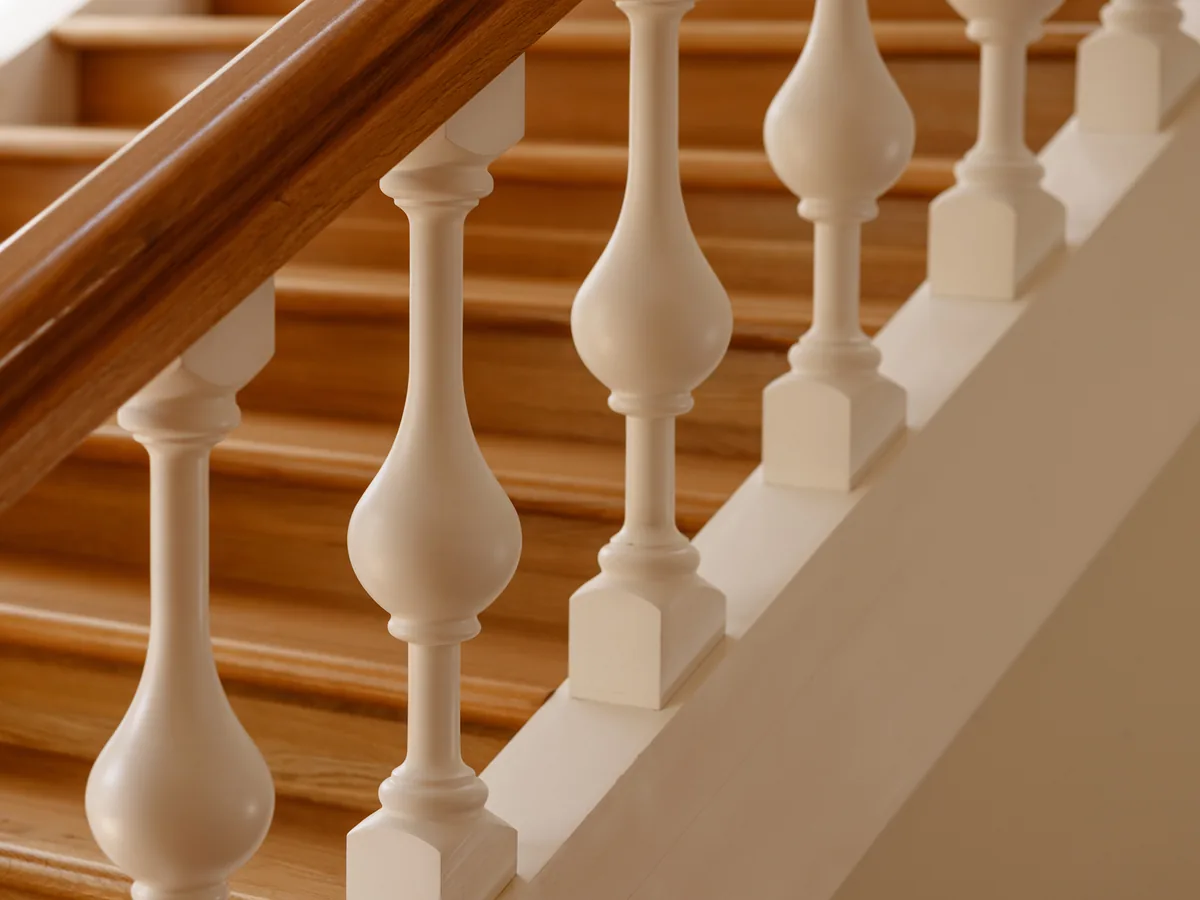
The right approach depends on the condition of your existing stairs and how much of them can be kept. All three options below cover the stair treads you walk on and the vertical risers behind them. Railings, balusters and newel posts are outside our scope, so your existing railing stays in place while we work. We also leave the painted skirt board along the wall in place, protecting it as we work around it. Filling, caulking, repainting or replacing the skirt board is trim work rather than flooring work and should be handled by your painter.
If you're unsure which option applies to your stairs, the condition of your existing treads and risers determines the right approach:
- If your treads are sound, solid hardwood and only the finish is worn: refinishing.
- If removing the carpet reveals construction-grade treads: new treads and risers, or an overlay if the existing steps are sound.
- If your steps are solid and their dimensions allow for the added thickness: a retread overlay.
- If a tread is loose, cracked or moves underfoot: we assess and repair it first, before proceeding with any of the three options.
New Treads and Risers on a Bare or Carpeted Stair
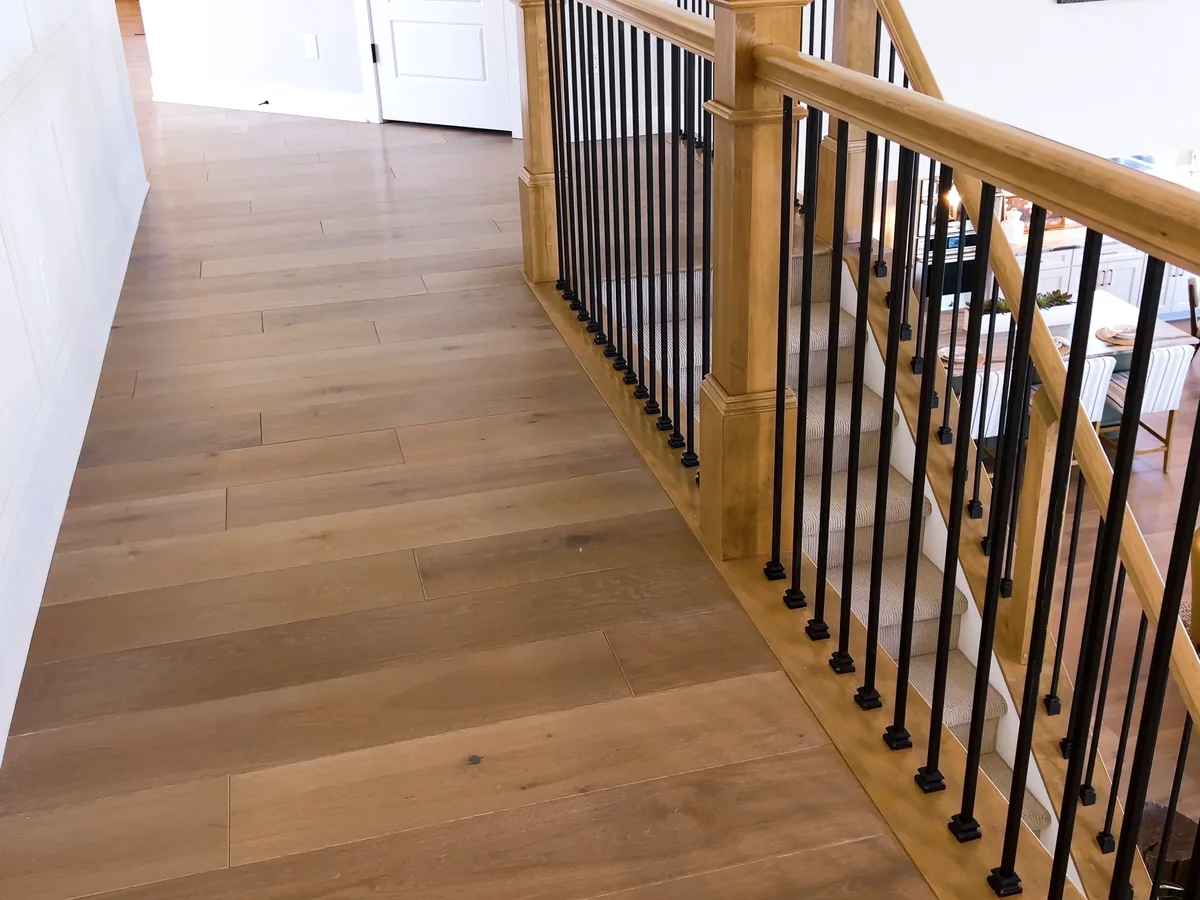
Full stair tread replacement is the answer when the existing wood was never intended to be exposed. This is common on carpeted stairs, where removing the carpet reveals rough, knotty treads. Builders use construction-grade pine or fir treads and plywood risers on stairs intended for carpet because the wood will be covered. For a carpet to hardwood stairs conversion, those materials need to be replaced rather than sanded and finished.
We remove the carpet, pad, tack strips and staples, inspect the stairs underneath, and cut new white oak treads and risers to fit each step. On stairs that are open on one side, we install return nosing to finish the exposed end. This shaped piece matches the rounded front edge of the tread and covers the cut edge. Carpet removal from floors is a separate service.
Refinishing the Treads You Already Have
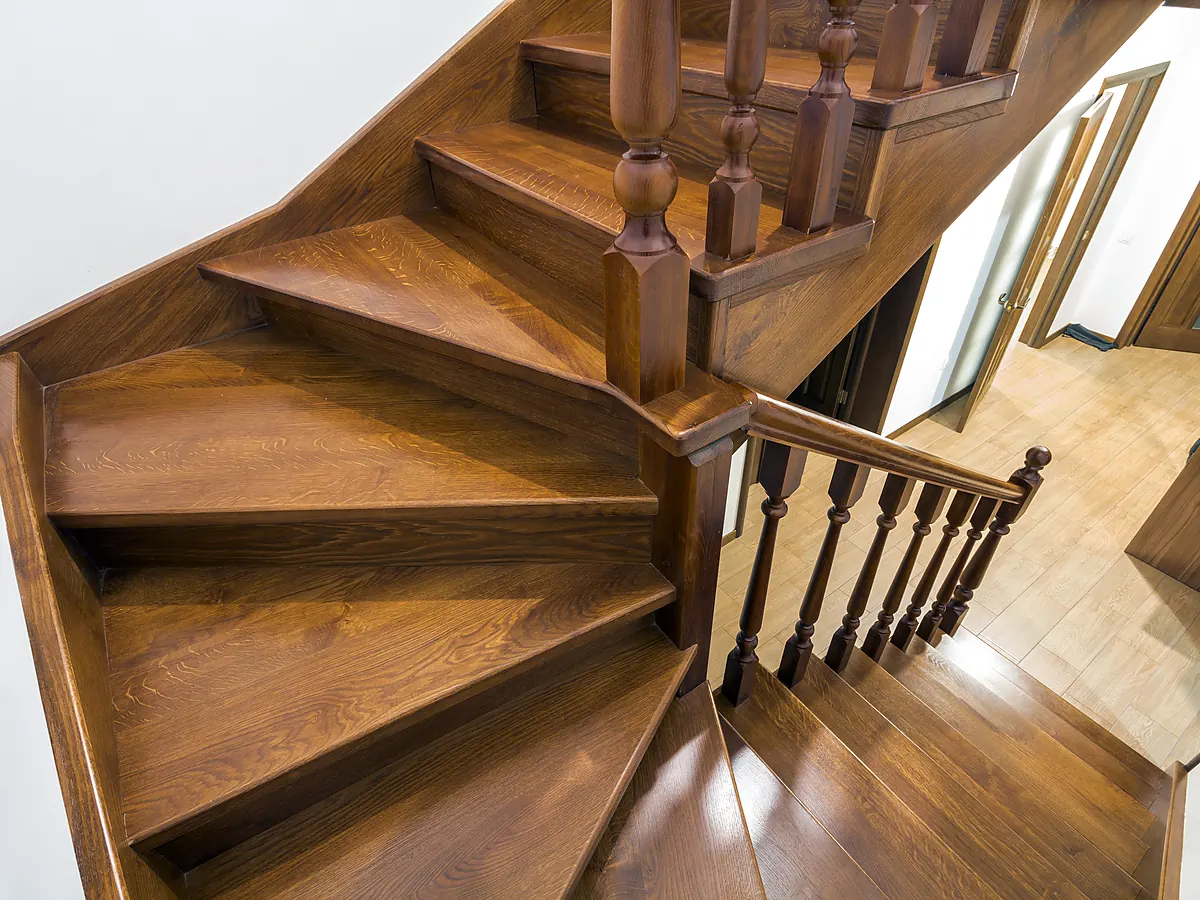
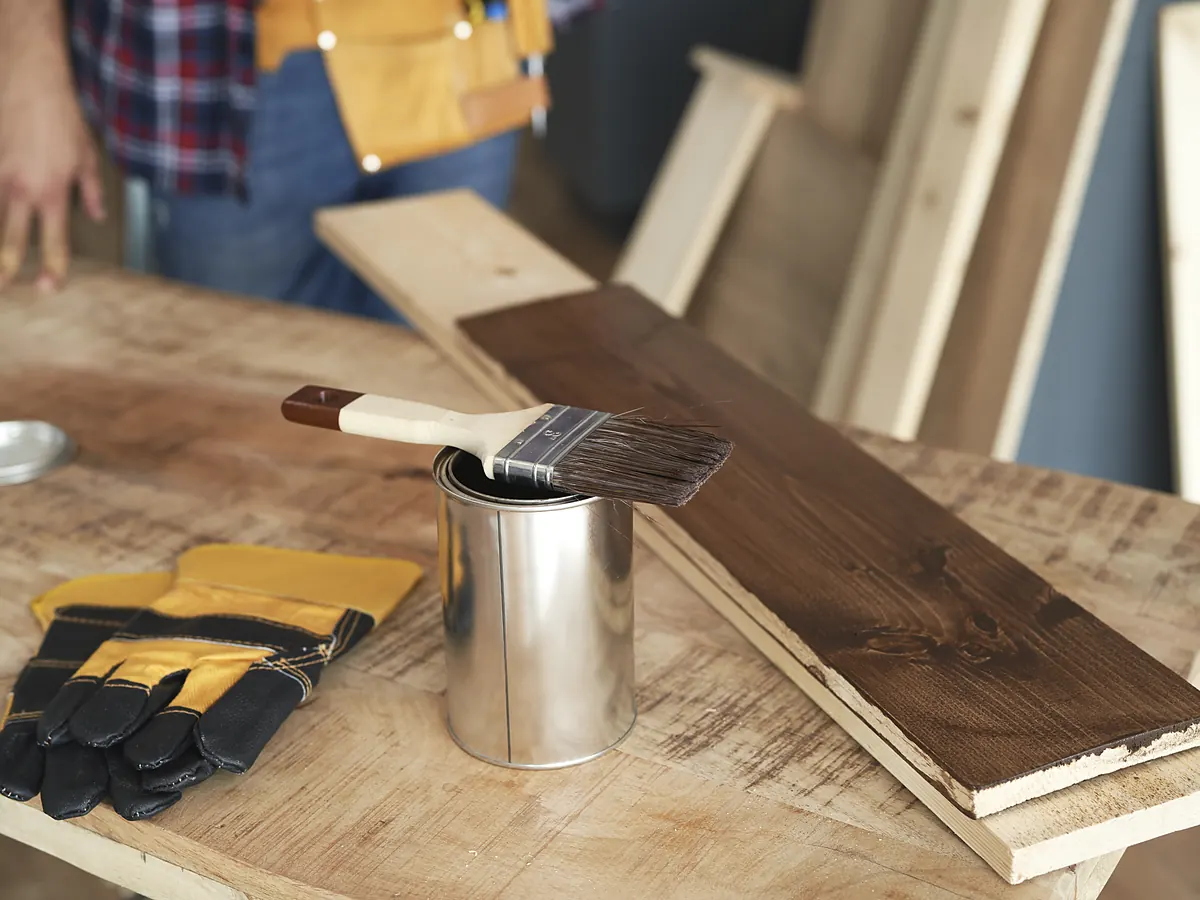
Hardwood stair refinishing is the right choice when the wood is sound but the finish has worn through. The wear is most visible down the middle of each tread, where foot traffic is heaviest, while the outer edges still have their original finish. We remove the old finish, sand the wood back to a clean surface, apply stain if you want to change the color, and build up new coats of finish.
Two conditions affect how we proceed. A tread that has already been sanded thin has little wood left for another refinishing. An old shellac finish, a brittle coating used on stairs for generations, must be removed down to bare wood rather than coated over. After decades of foot traffic, the remaining shellac is no longer a sound base for a new finish.
Retread Overlays Fitted Over the Existing Steps
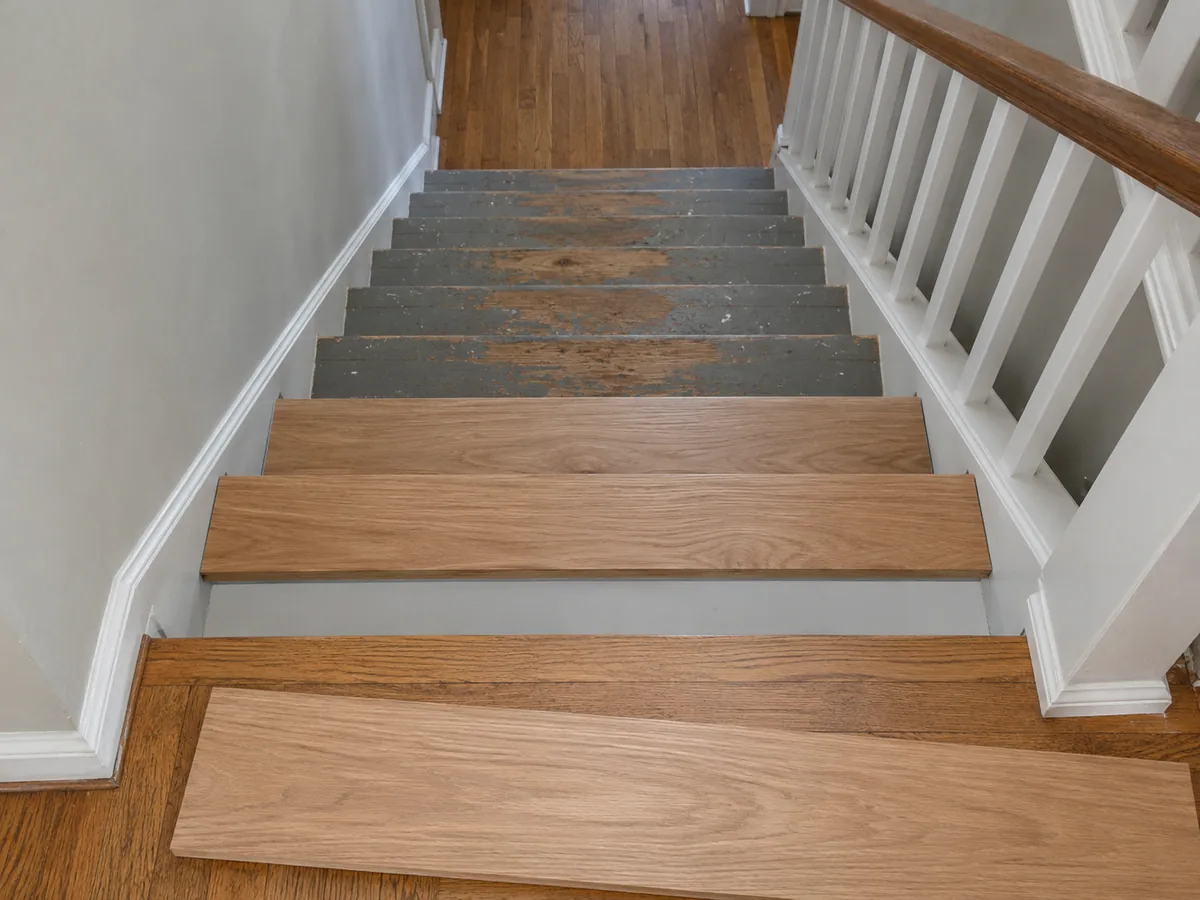
A retread overlay uses finished hardwood treads glued with construction adhesive and fastened over the existing steps, allowing you to install hardwood over existing stairs without removing the staircase. Because little demolition is needed, a stair tread overlay is a good choice when the stairs are structurally sound but the visible surfaces need replacing. It does not correct steps that move underfoot, and we’ll tell you if we find that problem. Adding thickness to each step also changes the stair dimensions at the top and bottom, which we explain in the code section below.
Treads, Risers and Stain Matching
We settle the wood species, edge profile and color before cutting any material, since each choice affects the others and changing a finished tread is expensive.
Choosing Tread and Riser Stock
Wood hardness matters more on stair treads than on an open floor because foot traffic is concentrated in a narrow area near the front edge of each step. How evenly the wood absorbs stain also matters when choosing a species. These two factors help distinguish the most common hardwood stair tread options:
- White oak is hard and absorbs stain evenly, making white oak stair treads a reliable choice when you want a consistent, predictable color.
- Red oak belongs where the stairs need to match existing red oak flooring elsewhere in the house.
- Hard maple is durable, but it absorbs stain unevenly and requires more careful preparation than oak to prevent blotching.
- Hickory and walnut are good choices when you want the natural grain pattern to stand out. Hickory is the hardest wood on this list, while walnut is the softest, even softer than either oak, so it wears faster in exchange for its appearance.
- Heart pine is used to match the wood on an older, period staircase.
We install solid hardwood stair treads, which have enough wood to be sanded and refinished again years later. Engineered and veneered stair caps are also available, but they have a thin wear layer over a core, and the thickness of that layer determines how many times they can be refinished, if at all.
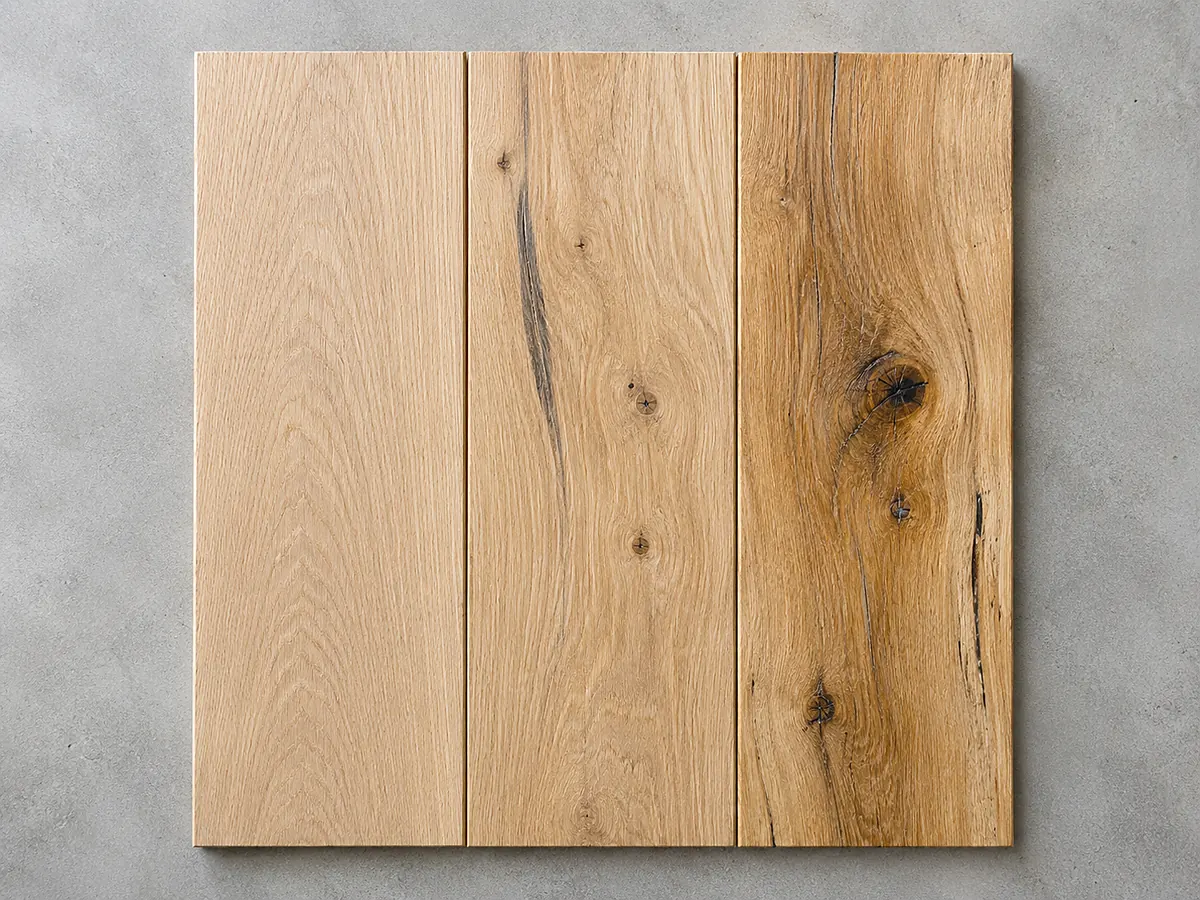
Character-grade wood includes natural knots and color variation, giving the stairs an older appearance while helping conceal small marks and scratches. Risers are a separate choice, with painted risers being the most common option. Both matte black and white are standard finishes, and painting the risers is a deliberate design choice rather than a compromise.
Matching New Treads to the Floor at the Landing
To match the stain on your stair treads to your existing floor, we test colors on offcuts of the actual tread stock and compare them in your stairwell. This matters because the same stain produces different colors on different wood species. Stairwells also receive light from above and from one side, so a sample that looks right on a workbench can look different once it is installed on the steps.
An exact color match between two different wood species cannot be promised, so we aim for a close match that allows for a small difference in tone. The most common situation is new oak stair treads meeting an older oak floor that has ambered over time, as the wood and its finish have developed a warmer, golden color from exposure to light. We mix your stair tread stain to match the floor as it looks today, not the color it was when first installed.
Hand Sanding Where a Floor Machine Cannot Reach
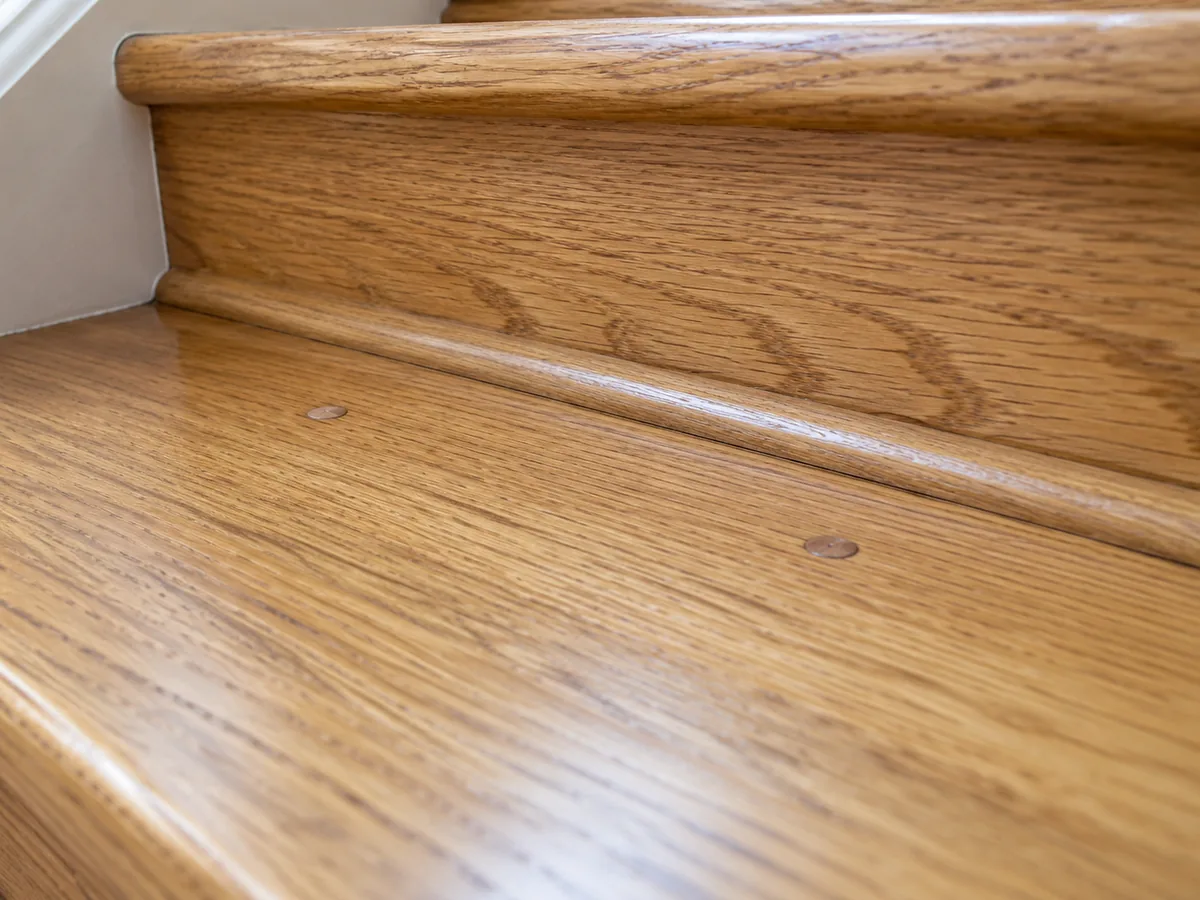
Hand sanding is necessary on stairs because the machines used on open floors cannot reach every part of a step, including the inside corner where the tread meets the riser, the rounded front edge and the narrow spaces beside each baluster. We use smaller sanding tools to reach these areas, leaving your existing railing in place and sanding around it by hand.
We choose sanding abrasives based on the existing finish, the condition of the wood underneath and the new coating being applied. The curved front edge requires a coarser abrasive than the flat tread surface because its shaped profile is harder to sand. Dust containment runs on every sander we use, on every job.
Squeaks, Loose Treads and the Work That Comes First
We repair any movement in your stairs before applying the finish because a coating only a few thousandths of an inch thick cannot hold a loose joint together. If a step moves before finishing, it will still move afterward. During your estimate, we stand on each tread to check for movement and identify repairs before any coatings are applied.
Where a Stair Squeak Actually Comes From
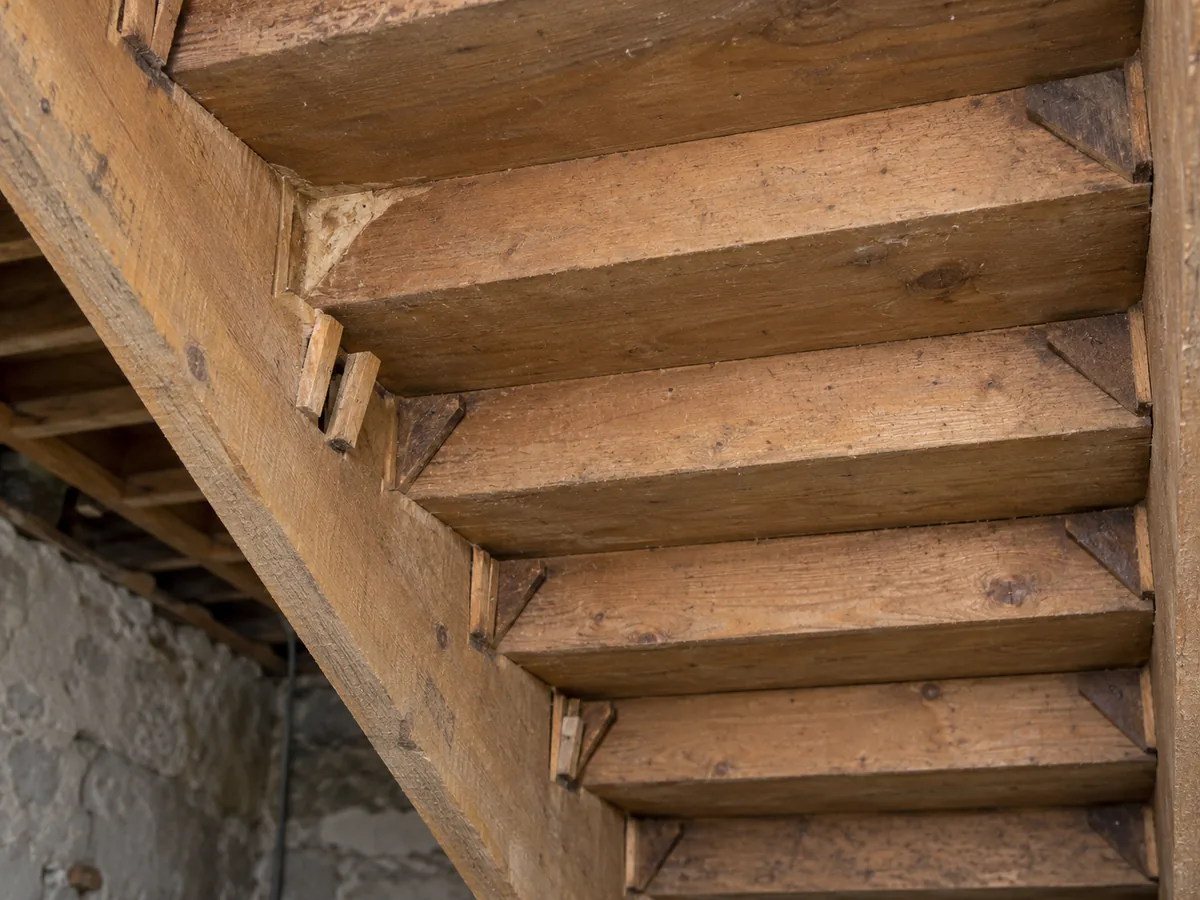
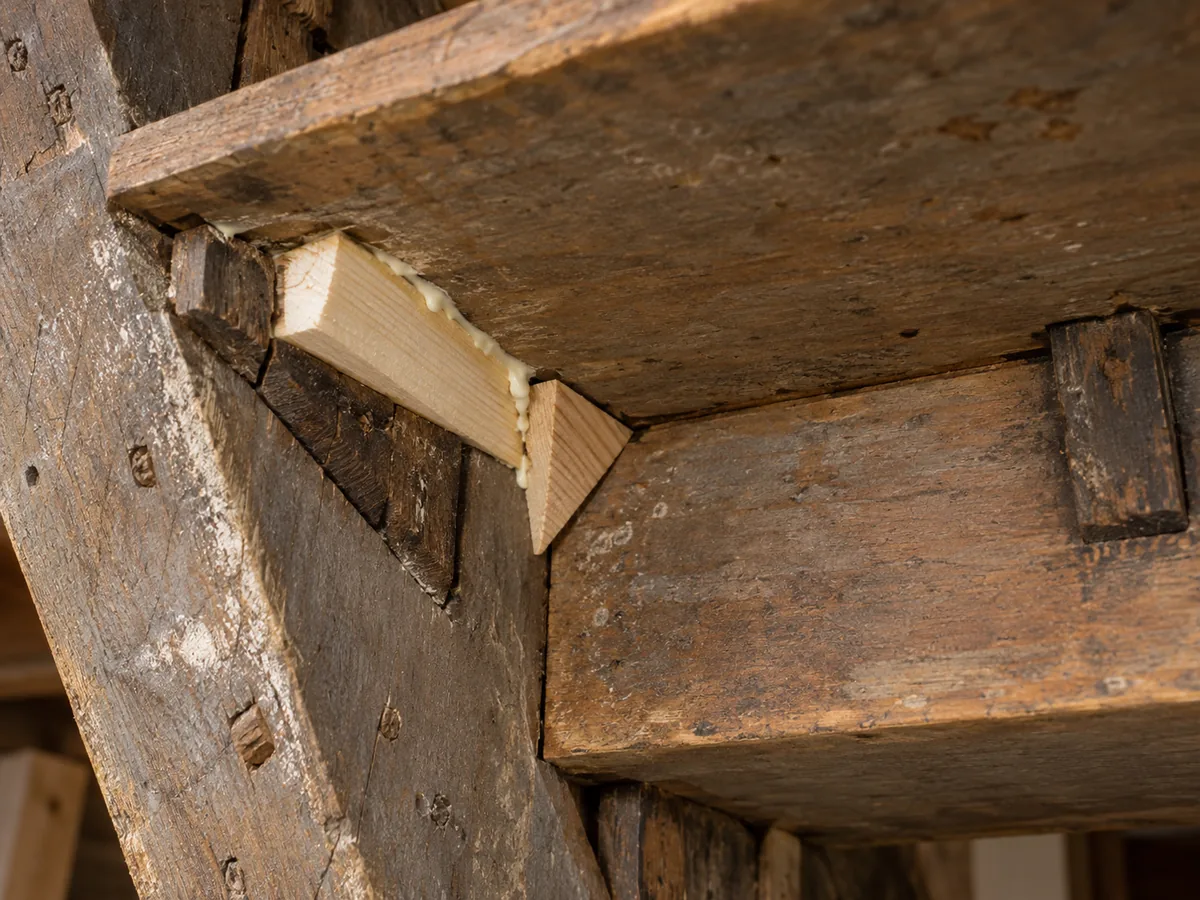
Squeaky stairs are almost always caused by wood rubbing against another piece of wood or a nail that no longer holds the joint tight. The usual sources are the back of a tread rubbing against the riser, a tread moving against the notched stringer supporting it, a loose glue block underneath, a wooden wedge that has dried out and loosened, or movement at the joint between the stairs and the skirt board along the wall.
We locate the loose joint by putting weight on the front and back of each tread and checking both sides, listening for where the squeak comes from. A loose stair tread is louder in January because heated indoor air is drier, causing the wood to shrink and loosen around its fasteners.
Fixing It From Below, or From Above When You Cannot
The repair method depends on whether we have access to the underside of your stairs. On basement stairs or any staircase without a finished ceiling underneath, we make the repairs from below without leaving visible marks on the treads. We apply adhesive and shims to loose joints, replace failed glue blocks and drive new wedges behind loose treads. Repairing from underneath is the preferred approach because the walking surface remains untouched.
When a finished ceiling blocks access from underneath, we repair squeaky stairs from above using the method the problem requires. This generally means pulling the loose tread tight against its supports and securing it with fasteners set below the wood surface and filled. The filled holes are much less noticeable than exposed fasteners, although they remain visible under a clear finish if you look closely. If the tread-to-riser joint has opened, we install three-quarter-inch oak quarter-round along the joint to cover the gap and stiffen the front edge. We secure the joint first, since the trim is not a substitute for a proper repair.
Why Sioux Falls Hardwood Flooring for Your Stairs
The sections above explain how we do the work. Here is what you can expect from our service, starting with how we price your stairs. Unlike flooring, which is measured by area, stair work is priced per step, so you can check the quantity on your estimate simply by counting the steps.
- Sioux Falls Hardwood Flooring is a local company with 15 years in business.
- We carry the insurance and bonding applicable to our work and can provide documentation on request.
- We provide free estimates and offer financing for larger projects.
- You receive a written estimate with a per-step price and each part of the work listed separately.
- We test and approve the stain color on offcuts of your actual tread stock, under the lighting in your stairwell, before applying any finish to the stairs.
- We identify and repair loose or moving steps before finishing, with those repairs included in the agreed scope of work.
Your written estimate includes the number of treads, risers, landings and winders; your chosen wood species and tread profile; and whether the stairs will be replaced, overlaid or refinished. It also lists the stain and finish materials, carpet removal and disposal where needed, any repairs or additional charges, and the expected work schedule.
If something turns up once the carpet is off, you hear about it before we act on it, with the revised scope and figure put to you in writing. Send us your stair details through the quote form and we will arrange a visit.
Pricing
What Hardwood Stair Installation and Refinishing Costs in Sioux Falls
We price stair work by the step, with two rates covering most residential stairs in Sioux Falls. Installing new treads and risers costs $100 to $225 per step, while refinishing existing steps, including sanding and applying a new finish, costs $40 to $75 per step. These are per-step rates, not total project prices. Your actual price is determined after we inspect your stairs and count the steps during an on-site estimate.
What each rate includes is just as important as the price when comparing estimates. The installation rate covers fabricating each tread, fitting it to the step and finishing it. The refinishing rate covers sanding and finishing the treads, risers and nosings, including the detailed handwork between them. Carpet removal and haul-away, subfloor preparation such as removing staples and patching, and any subfloor replacement are priced separately when needed. A minimum charge applies to very small staircases because the setup work remains the same regardless of how many steps are involved.
Counting Steps, Landings and Winders
For pricing, one step includes one stair tread and the riser beneath it, so you can count your steps before we visit. Landings and winders are priced differently. A landing is the flat floor area where a staircase changes direction, so it is measured by area rather than counted as a step. A winder is a wedge-shaped tread used to turn the staircase. It is still priced per step but falls toward the higher end of the range because its edges are different lengths and require more fitting. Return nosing on an open-sided step is included in the per-step price, not charged separately.
What Moves a Job Inside the Range
The wood you choose has the biggest effect on price. Oak sits at the lower end of the range and is what we fit most often here, while walnut, hickory and character-grade wood cost more. Heart pine for a period staircase requires special sourcing rather than standard stock, which adds time before installation begins. Painted risers cost less than stained risers because the paint covers the natural wood color and grain, so no matching is needed. Changing the stain color adds an application step and drying time, with the extra work and waiting days pushing the project toward the higher end of either price range.
What the Old Stairs Turn Out to Be Hiding
We cannot know the full condition of your stairs until the carpet comes off. Removing it can reveal hundreds of staples and tack strips that need pulling, treads that were never intended to be exposed, old shellac finishes or loose steps that move underfoot. These findings change the scope of work rather than the per-step rate. We price any additional repairs based on what is needed, provide the cost in writing and get your approval before proceeding. No extra work begins without written authorization.
Phasing Stairs in an Occupied House
Most homes have only one staircase, so Sioux Falls Hardwood Flooring plans access between floors with you before the job begins. Whether the work can be staged depends on your stair layout, the products going on and whether the house has another way between floors.
When the staircase allows us to work in stages, we finish alternate steps first and return for the rest once the first set can take weight. This is a work method for our crew, not a way to keep the stairs open for normal use. A partially finished staircase has uneven footing and steps that are not ready to use, creating a fall risk for children, older adults and anyone carrying items.
Some stages require closing the staircase completely, particularly while adhesive sets beneath new treads or a new finish cures. The required waiting times come from the product manufacturers, and we include the expected closure periods in your written estimate.
We complete the work in the following order, with each stage finished before the next begins:
-
1.
We measure your stairs on site and confirm the step count with you before ordering materials.
-
2.
We plan stair access together, including which areas remain usable, which need to close and for how long.
-
3.
We remove the existing materials as needed and repair any loose or moving parts of the staircase.
-
4.
We fit the new treads and risers or sand the existing ones, depending on the work you've chosen.
-
5.
We apply stain if you're changing the color, followed by the required finish coats, allowing the drying and curing times specified by the manufacturer.
-
6.
We walk through the finished staircase with you and check the completed work against the step count in your proposal.
Four separate spans make up how long your stair is affected, and only the first is ours to put a number on. Active work, the fitting or sanding, runs about one to two days on a typical straight flight; a landing, winder steps, squeak work found at demolition or a color change all extend it. Stain and coating follows, with the coat count and the waits between them set by the finish you choose.
Restricted access overlaps both of those: the stages when part or all of the flight is out of use, which we map out with you at the measure. Full cure comes last and runs well past the day we leave, with socks before shoes and shoes before furniture.
No two staircases get the same timeline, so your written estimate carries the schedule for yours.
Stair Rise, Run and the Nosing You Walk Over
It helps to understand the stair dimensions required by the International Residential Code before work begins. The code sets a maximum riser height of 7 3/4 inches and a minimum tread depth of 10 inches, with Sioux Falls adopting a specific edition. There are two important exceptions to consider. Older staircases were built under the requirements in effect at the time, and refinishing them does not change their dimensions to meet today's standards. When a staircase is altered rather than built new, the local building department determines which code requirements apply to that work.
Why a Retread Overlay Changes Your Riser Heights
Overlay stock adds the same thickness to the top of every step, so the riser heights between steps stay the same. The difference occurs at the top and bottom of the staircase, where the new tread surfaces meet floors that have not changed. This can leave the first and last risers at different heights from the rest. The direction and size of those differences depend on how the landings and finished floors at each end are handled, so we measure and work out the dimensions for your specific staircase before installing the overlays.
The code allows no more than a 3/8-inch difference between the tallest and shortest risers in a flight. Adding a 3/4-inch overlay is enough to exceed that limit. We account for the added thickness and adjust the top and bottom steps separately to keep the riser heights within code limits. Your estimate should address these adjustments rather than leave them out of the scope.
Nosing Projection, and When a Tread Needs None
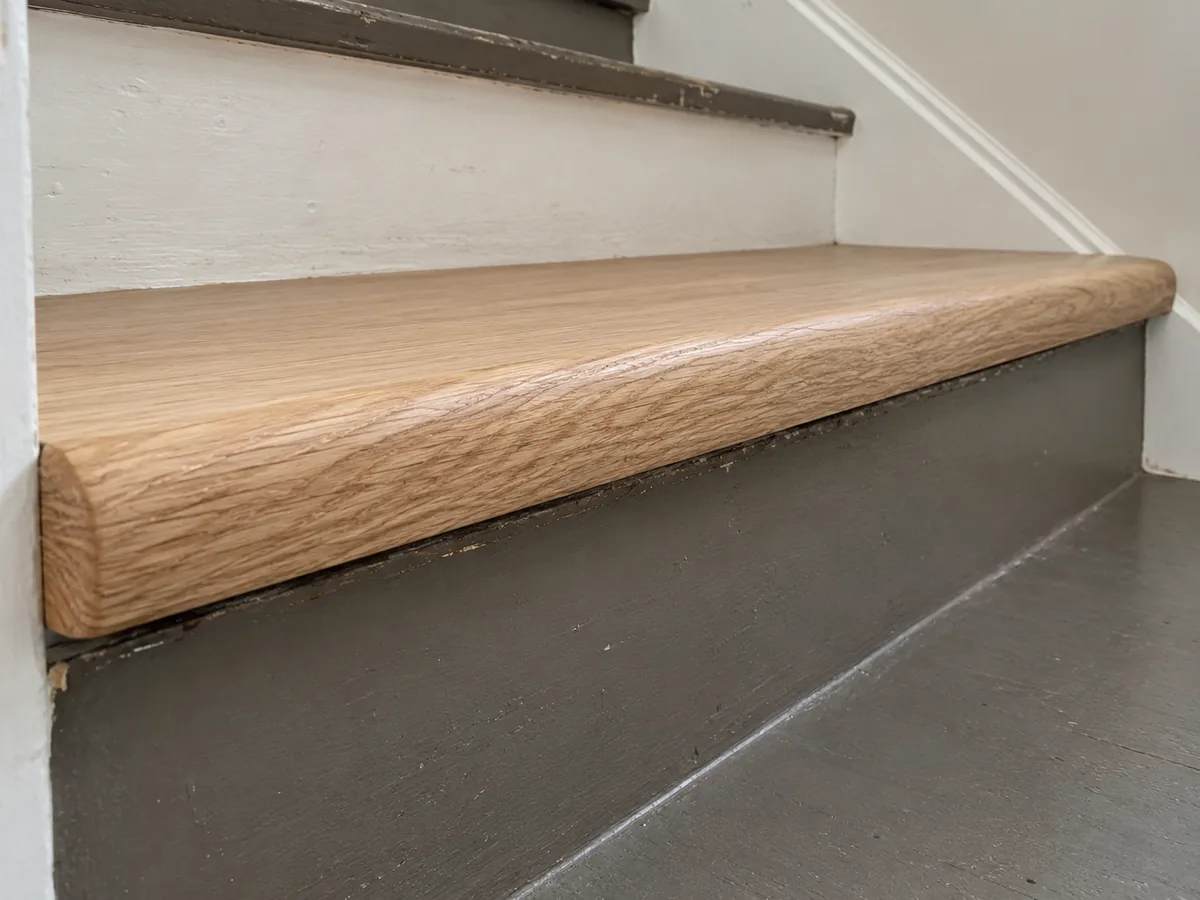
The stair nosing is the front edge of each tread that extends beyond the riser below, providing additional space for your foot. It runs along the walking edge of the step and is separate from the finished end of a tread on a staircase that is open on one side.
For stair treads shallower than 11 inches, the International Residential Code requires the nosing to extend at least 3/4 inch and no more than 1 1/4 inches beyond the riser below. The difference between the largest and smallest nosing projections in a flight cannot exceed 3/8 inch. Once a tread reaches 11 inches in depth, a projecting nosing is no longer required, so the front edge can be flush with the riser.
A replacement tread must be shaped to match the nosing profile of the steps above and below it, not simply cut to length. Keeping that profile consistent ensures your foot meets the same edge on every step rather than catching differently on the new one.
Sheen, Slip and the Finish That Goes on a Tread
Secure footing matters on stairs, which is why satin and matte finishes are common choices for treads. Your stairs do not need to have the same sheen as the adjoining floor. The important distinction is that a coating's grip depends on the coating itself, not how glossy it looks. Sheen affects appearance and how visible scratches are, rather than how much traction the stairs provide.
Durability matters just as much. Stair treads take more concentrated wear than an open floor, so we use a harder-wearing finish to protect them.
We use three different stair finish systems, each with its own characteristics. Bona Traffic HD is a two-component waterborne coating. Rubio Monocoat is a hardwax oil that penetrates the wood rather than forming a film on the surface. Oil-based polyurethane is a traditional film-forming finish. Each product has different preparation requirements, coat counts, recoat intervals and curing times, so we follow the manufacturer's instructions for the finish you choose rather than using the same process for every staircase. We explain the advantages and drawbacks of each option so you can decide which suits your stairs.
What Hardwood Stairs Need After the Finish Cures
A freshly coated staircase needs several days for the finish to harden fully, followed by regular maintenance to keep it in good condition. Hardwood stair care requires more attention than floor care because everyone uses the same narrow path up and down the steps, concentrating wear in those areas. How you care for your refinished stairs during the first season after the satin topcoat is applied has a direct effect on how many years the finish lasts.
Grit, Snowmelt and the First Sioux Falls Winter
Sioux Falls, South Dakota gets about forty-five inches of snow each year, and boots track snow, sand and de-icing salt onto the bottom stair treads. The water dries, but the sand and salt remain, scratching the finish as people walk over them. A mat or boot tray inside the entrance catches most of this material before it reaches the stairs. The bottom treads also need more frequent sweeping or damp wiping than the upper steps. Even with regular care, the lowest two or three treads will lose their sheen before the rest of the staircase. This is normal wear that a recoat is intended to address.
When Stairs Come Back for a Lighter Pass
Years of foot traffic gradually wear down the finish on your stairs, but if the coating has not worn through to bare wood, you do not need a full refinish. Refinishing removes the existing finish down to bare wood and applies a new finish system. A recoat instead lightly abrades the existing coating and adds a fresh coat over it. Recoating takes less time, costs less and is available as a separate service, which we explain on its own page.
Your stairs are suitable for a recoat when the finish has worn thin along the main walking area but still covers the wood, with no bare spots or gray or black staining. Two conditions rule out a standard recoat. If the wood is exposed or stained, adding another coat will not correct the damage. The existing finish must also be compatible with the process. A waterborne finish can be abraded and recoated, while a hardwax oil requires a different maintenance method.

Service Area
Stair Work Across Sioux Falls and the Surrounding Communities
We serve Sioux Falls, Minnehaha and Lincoln Counties, and surrounding communities within approximately 30 miles. We use the same per-step pricing throughout our service area, so your location does not change the rate. Your estimate depends on the condition and layout of your staircase and the work it needs.
Where Sioux Falls Hardwood Flooring Builds and Refinishes Stairs
Sioux Falls Hardwood Flooring builds new stair treads and refinishes worn ones throughout Sioux Falls, South Dakota, and if your house sits beyond the city limits you are still inside the area we cover. We cover sixteen communities across Minnehaha, Lincoln, and neighboring counties:
Communities We Serve
- Brandon
- Harrisburg
- Tea
- Hartford
- Dell Rapids
- Lennox
- Canton
- Crooks
- Baltic
- Worthing
- Valley Springs
- Garretson
- Humboldt
- Colton
- Renner
- Chancellor
FAQ
Hardwood Stair Installation and Refinishing Questions We Get
How much does it cost to redo stairs in hardwood?
Installing new stair treads and risers costs $100 to $225 per step, while refinishing existing stairs costs $40 to $75 per step. After inspecting your staircase, we provide a written estimate confirming which rate applies and listing any work priced separately.
Can you put hardwood over existing stairs?
Yes, where the stair underneath is solid and the step dimensions leave room for the added thickness. The catch is riser height: adding the same thickness to every tread leaves the two end steps out of line with the rest, so those get worked separately to stay inside what the code allows.
Can you match new stair treads to my existing hardwood floor?
We aim for a close color match rather than promising an exact one. We mix and test the stain on offcuts of the same wood used for your new treads, then judge them under your own stairwell light. Matching the same species gets much nearer, while an exact match across two species is not something anyone can promise.
Can we still use the stairs while you work on them?
You can use the stairs during certain parts of the project, but access depends on the staircase and the work being done. Some staircases can be completed in stages, while others must be closed entirely, especially while adhesive sets or a new finish cures. A partially completed staircase is not safe for normal use, so we explain all access restrictions and closure periods before work begins.
Do you replace the railing and balusters as well?
No, railing work is carpentry rather than flooring, so it is outside our scope. We work on the stair treads, risers and nosings, leaving your existing railing securely bolted in place throughout the job so the staircase is never left with an open side.
Why are stairs priced per step instead of per square foot?
Because stair labor depends on the number and shape of the steps, not their square footage. Thirteen narrow treads can cover the same area as an open room but take much longer to install or refinish. Pricing by square foot would also treat a winding staircase the same as a straight one, even though the winding steps require more fitting and labor.
Get a Per-Step Stair Price
We come to the house and put a written per-step stair price on paper for the work your staircase needs, whether that is a hardwood stair estimate for new treads or a stair refinishing quote for the ones you already walk on. Call (605) 799-9142 for a free on-site estimate, or use the quote form to request a proposal.